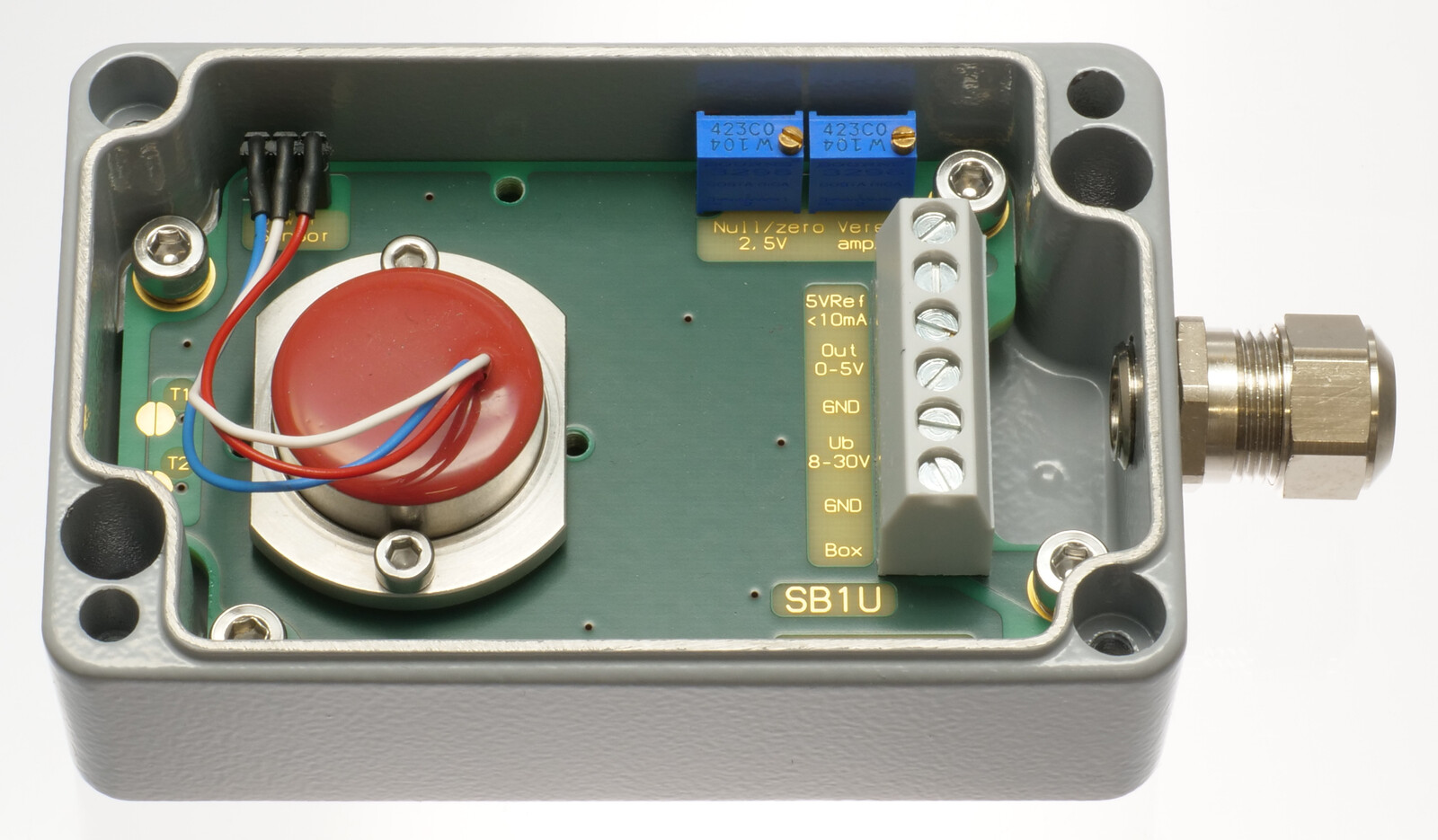
Sensorbox containing one sensor and one signal conditioner with 0.5 ... 4.5 Volt output
Features
- robust pressure die cast aluminium housing (IP67) with saltwater proof coating
- twist free 4-point fastening of rigid, 3.2mm thick base PCB
- integrated signal conditioner with 0.5 ... 4.5 Volt output
- temperature drift compensation of the sensitivity
- 9V ... 30V supply voltage
- all SEIKA sensors fit the housing and can be installed in different directions of operation
- the output signal of the sensor is calibrated to customer's specifications in the required direction of operation
- sensor and signal conditioner electrically isolated from housing
- EMC certified
- highly stable sensor supply voltage
- programmable dynamic response
- high mechanical overload resistance
- low pass filter with optional choice of cut-off frequency for suppression of interference frequencies
Description
The SB1U is a pressure die cast aluminium sensor housing (IP67) with an integrated sensor for measuring uniaxial acceleration or inclination.
As well as the sensor, the box contains a signal conditioner with 0.5 ... 4.5 Volt output and a separate, highly stable supply voltage that can be used externally as a reference point. Furthermore, the signal conditioner includes an active low pass filter, whose upper cut-off frequency / settling time can be adjusted to suit the measurement task, and a noise voltage filter to guarantee the EMC. Interference signals caused by unwanted ground currents are eliminated by electrically isolating sensor and signal conditioner from the housing. Unlike the SB2.., the SB1U can accommodate larger inclinometers, such as the NG.. series, that have a higher measuring accuracy. Electronic temperature compensation largely compensates for the temperature drift of the implemented sensor's sensitivity. Optionally, the temperature drift of both offset and sensitivity can be reduced significantly through individual compensation.
The compact metal cable gland and small housing size in combination with the max. 5-wire connection enable the use of this high quality measuring system in harsh operating conditions.
Application
The SB1U is suitable for applications requiring precise inclination or acceleration measurements under harsh circumstances and returning of a 0.5 ... 4.5 Volt output signal. Areas of successful implementation include construction, mining, agricultural machinery, transportation and conveyor systems, ships, operation and automation technology as well as general mechanical engineering.
Specifications
| Terminals | 6 x 1.5 mm2 |
| Cable gland | M12 x 1.5, metal cable gland with integrated strain relief, clamping range 6mm ... 7.5mm |
| Measuring range, Resolution, etc. | depending on implemented SEIKA sensor |
| Degree of protection | IP67 |
| Mounting orientation | any (standard: wall mounting, cable on the right) |
| Measuring planes (N sensor) | 3 main housing planes |
| Measuring plane (NG sensor) | parallel to bottom of housing |
| Measuring directions (B or BDK sensor) | X,Y,Z coordinates of housing |
| Torque housing lid | 1.5Nm |
| Supply voltage | 9V ... 30V |
| Operating current | approx. 2mA |
| Normalized output voltage range | 0.5V ... 4.5V |
| Output zero point | 2.5 Volt |
| Maximum output voltage range | 0.05V ... 4.95V |
| Output resistance | 100 Ohm |
| Capacitive output loading capacity | any, taking dynamic requirements into account |
| Output reference voltage | 5±0.0025 Volt (max. 5mA, max. 5ppm/K) |
| Adjustable variables | zero point (2.5V), amplification |
| Low pass filter | active, 5th order, minimal ripple |
| Operating temperature | -40...+85°C |
| Weight | approx. 300g |
- • The box is delivered with an individual calibration record that includes the precise offset and sensitivity values, the static characteristic curve and the linearity deviation curve.
Options:
- • special measuring ranges • silicon encapsulation • custom wiring
- • individual temperature drift compensation of the offset and the sensitivity
 3D geometry as STEP file
Dimensions (in mm) and Connections
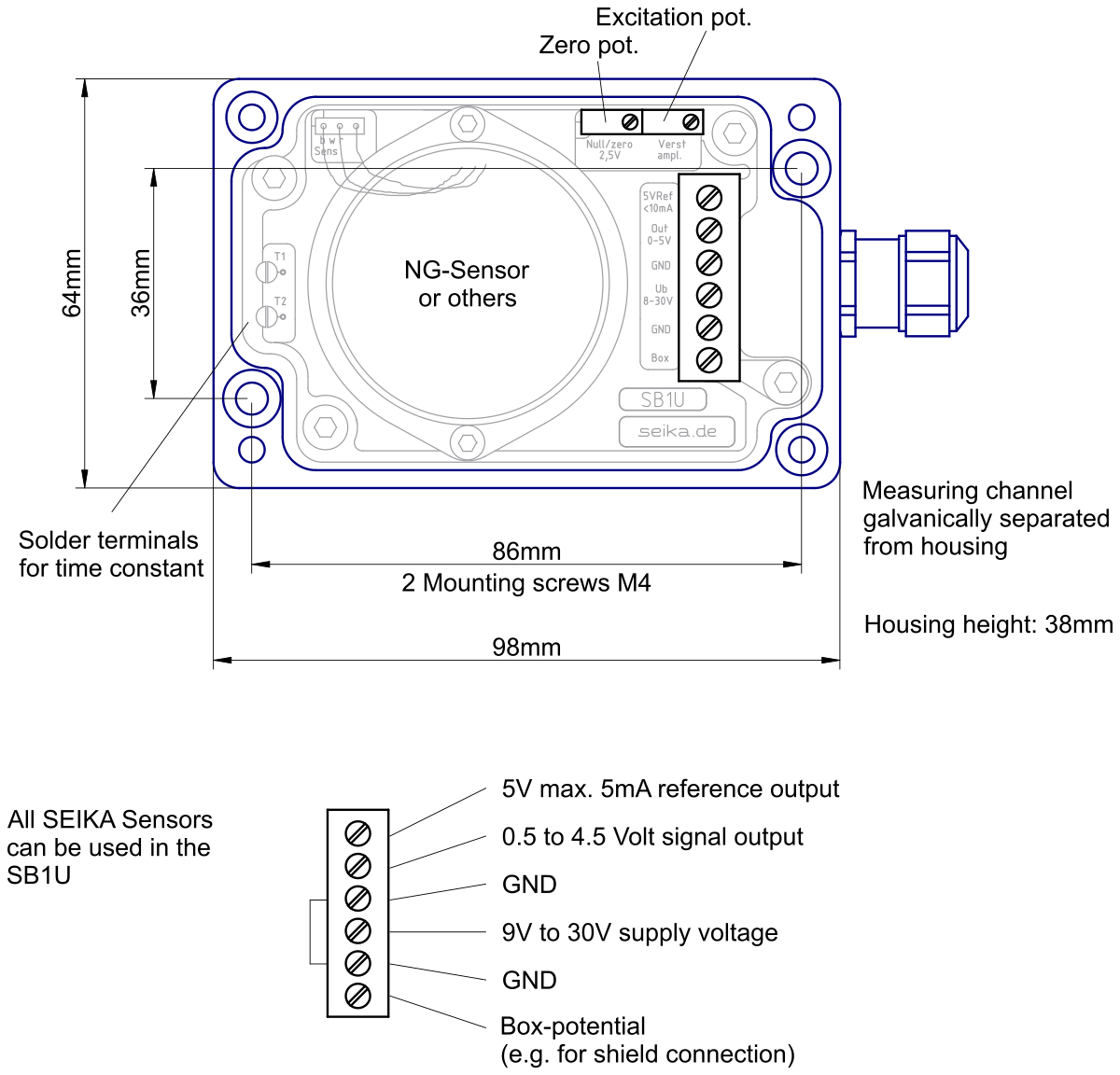
Measuring planes and directions for N..., NB..., B... und BDK... sensors: